The entries below use the same source as the Japanese page. Titles of Japanese-language works and linked articles retain their original language.
Peptide and middle-molecule drug discovery
Takashi Tajimi, Naoki Wakui, Keisuke Yanagisawa, Yasushi Yoshikawa, Masahito Ohue, Yutaka Akiyama: Computational prediction of plasma protein binding of cyclic peptides from small molecule experimental data using sparse modeling techniques, BMC Bioinformatics, 19(Suppl 19): 527, 2018. doi: 10.1186/s12859-018-2529-z
[ PubMed | Journal Website ]
「ペプチド創薬の最前線」, 木曽良明監修, シーエムシー出版, 2019/5/14. (分担執筆: 秋山泰, 大上雅史, 吉川寧, 和久井直樹: 第8章 中分子創薬に適した特性を有する環状ペプチドのインシリコ設計, pp. 70-78)
https://www.cmcbooks.co.jp/products/detail.php?product_id=5619
Ligand-based Virtual Screening
We develop machine learning methods that use measured activity data to predict the activity of unseen compounds against a target.
Learning to Rank
Masahito Ohue, Shogo D. Suzuki, Yutaka Akiyama: Learning-to-rank technique based on ignoring meaningless ranking orders between compounds, Journal of Molecular Graphics and Modelling, 92:192-200, 2019. doi: 10.1016/j.jmgm.2019.07.009
[ PubMed | Journal Website | github ]
Shogo D. Suzuki, Masahito Ohue, Yutaka Akiyama: PKRank: A novel learning-to-rank method for ligand-based virtual screening using pairwise kernel and RankSVM, Artificial Life and Robotics, 23(2): 205-212, 2018. doi: 10.1007/s10015-017-0416-8
[ Journal Website ]
Graph Convolutional Deep Neural Network
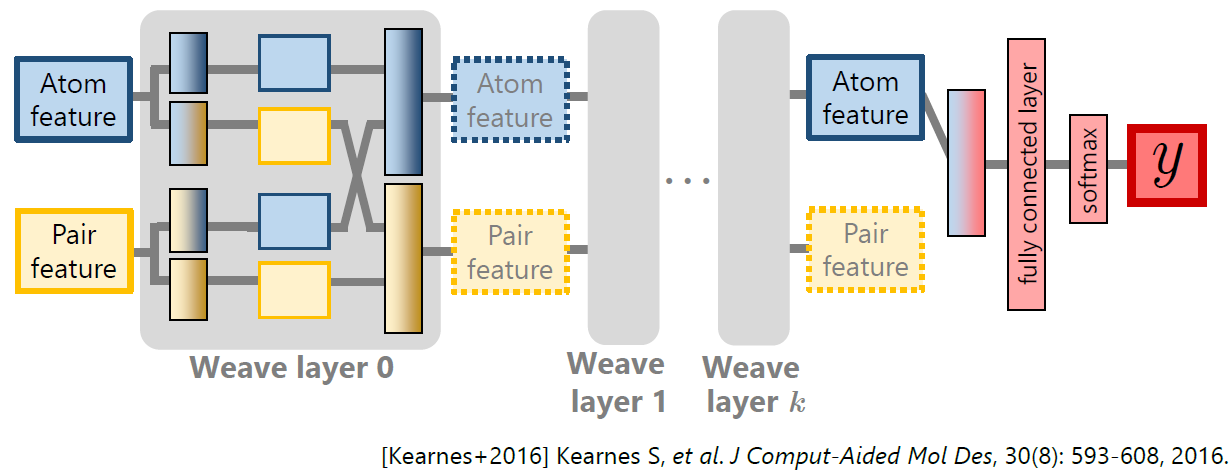
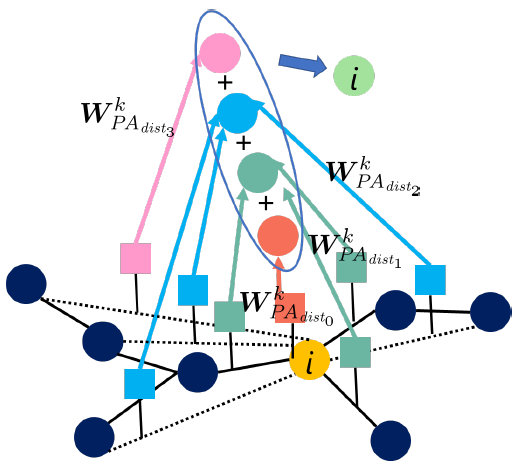
- Masahito Ohue, Ryota Ii, Keisuke Yanagisawa, Yutaka Akiyama: Molecular activity prediction using graph convolutional deep neural network considering distance on a molecular graph, In Proceedings of the 2019 International Conference on Parallel and Distributed Processing Techniques & Applications (PDPTA'19), 122-128, Las Vegas, NV, USA, July 29, 2019.
[ Paper | arXiv | Slide ]
Drug-target interaction prediction
We develop methods for predicting bipartite interaction networks between proteins and drugs.
NRLMFβ
We developed a neighborhood-regularized logistic matrix factorization method that rescales predictions using a beta distribution.
Tomohiro Ban, Masahito Ohue, Yutaka Akiyama: NRLMFβ: Beta-distribution-rescored Neighborhood Regularized Logistic Matrix Factorization for Improving Performance of Drug–Target Interaction Prediction, Biochemistry and Biophysics Reports, 18:100615, 2019. doi: 10.1016/j.bbrep.2019.01.008
[ PubMed | Journal Website | github ]
BO-DTI
Bayesian optimization using the GP-MI method reduced training time for DTI prediction by approximately a factor of ten.
- Tomohiro Ban, Masahito Ohue, Yutaka Akiyama: Efficient Hyperparameter Optimization by Using Bayesian Optimization for Drug-Target Interaction Prediction, In Proceedings of the 7th IEEE International Conference on Computational Advances in Bio and Medical Sciences (ICCABS 2017), 8 pages, Orlando, FL, USA, October 19-21, 2017. doi: 10.1109/ICCABS.2017.8114299
[ Download * | IEEE Xplore | Slide ] *2017 IEEE. Personal use of this material is permitted. Permission from IEEE must be obtained for all other uses, in any current or future media, including reprinting/republishing this material for advertising or promotional purposes, creating new collective works, for resale or redistribution to servers or lists, or reuse of any copyrighted component of this work in other works. http://www.github.com/akiyamalab/BO-DTI
Link Indicator Kernel
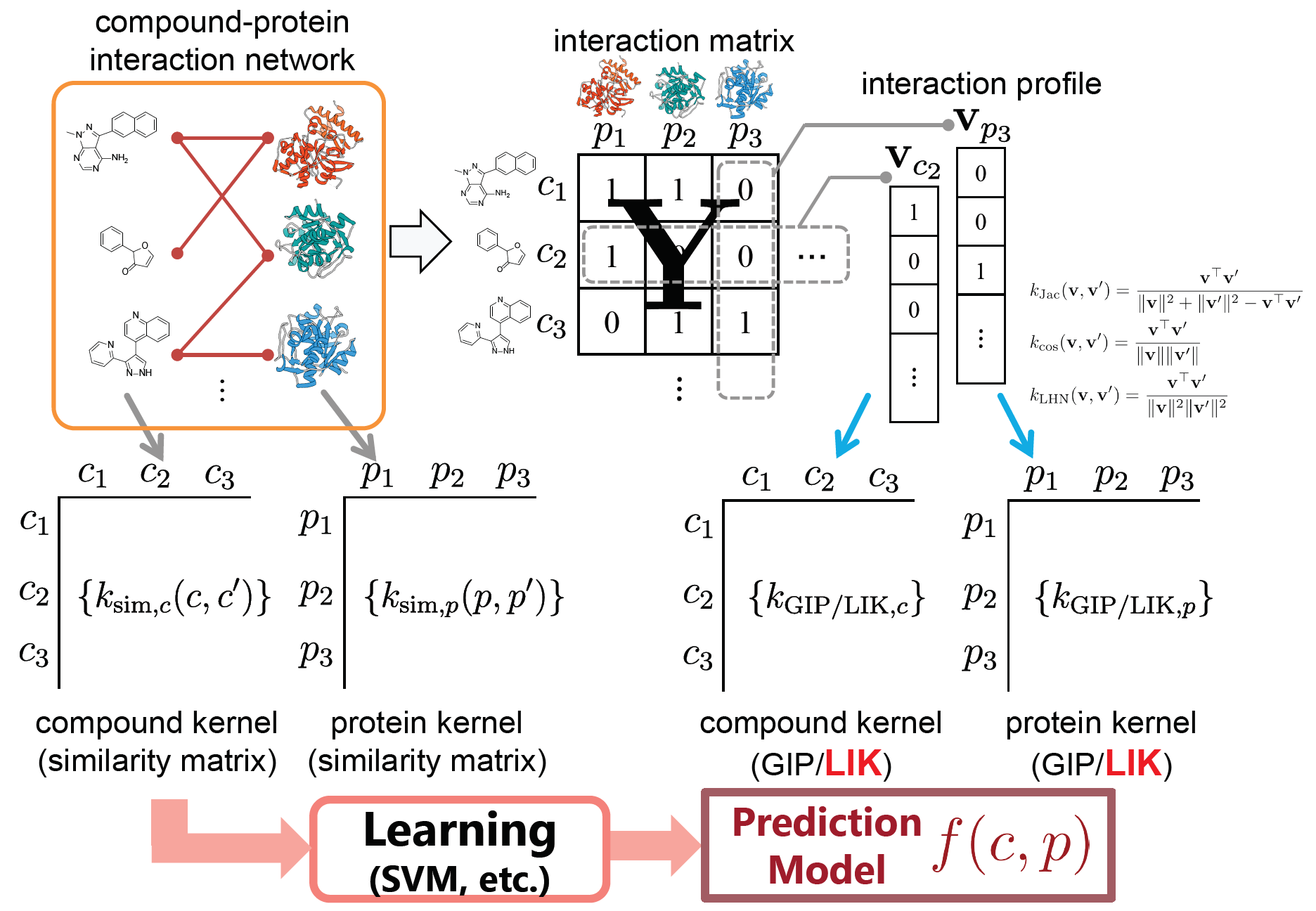
We proposed a multiple-kernel method using link indicators.
- Masahito Ohue, Takuro Yamazaki, Tomohiro Ban, Yutaka Akiyama: “Link Mining for Kernel-based Compound-Protein Interaction Predictions Using a Chemogenomics Approach”, In Proceedings of the Thirteenth International Conference On Intelligent Computing (ICIC2017) (Lecture Notes in Computer Science), 10362, 549-558, Liverpool,UK August 7-10, 2017.
[ Paper | arXiv | Slide ]
Spresso

Spresso provides fast compound prescreening based on three-dimensional protein structures. http://www.bi.cs.titech.ac.jp/spresso
Keisuke Yanagisawa, Shunta Komine, Shogo D. Suzuki, Masahito Ohue, Takashi Ishida, Yutaka Akiyama: Spresso: An ultrafast compound pre-screening method based on compound decomposition, Bioinformatics, 33(23): 3836-3843, 2017. doi: 10.1093/bioinformatics/btx178
[ PubMed | Journal Website ]
Keisuke Yanagisawa, Shunta Komine, Rikuto Kubota, Masahito Ohue, Yutaka Akiyama: Optimization of memory use of fragment extension-based protein-ligand docking with an original fast minimum cost flow algorithm, Computational Biology and Chemistry, 74: 399-406, 2018. doi: 10.1016/j.compbiolchem.2018.03.013 (In Proc. APBC2018)
[ PubMed | Journal Website | slide ]
MEGADOCK-Web
Takanori Hayashi, Yuri Matsuzaki, Keisuke Yanagisawa, Masahito Ohue*, Yutaka Akiyama*: MEGADOCK-Web: an integrated database of high-throughput structure-based protein-protein interaction predictions, BMC Bioinformatics, 19(Suppl 4): 62, 2018. doi: 10.1186/s12859-018-2073-x (In Proc. APBC2018)
[ PubMed | Journal Website | slide ]
大上雅史, 林孝紀, 秋山泰: タンパク質間相互作用と複合体構造の予測結果を検索できるウェブサイト「MEGADOCK-Web」, 実験医学, 2019年6月号, Vol.37, No.9, pp. 1469-1474, 2019/5/20.
[ 羊土社 ]
MEGADOCK

MEGADOCK predicts protein-protein interactions using three-dimensional protein structures.
Its FFT-based docking algorithm combines an improved scoring model with thread-level parallelism
to achieve fast computation.
Learn more: Software (Japanese)
Also listed in the NVIDIA Application Catalog: https://www.nvidia.com/en-us/data-center/gpu-accelerated-applications/catalog/
Protein-protein docking prediction
We study fast methods for predicting complex structures by evaluating shape complementarity and interactions between surface charges.
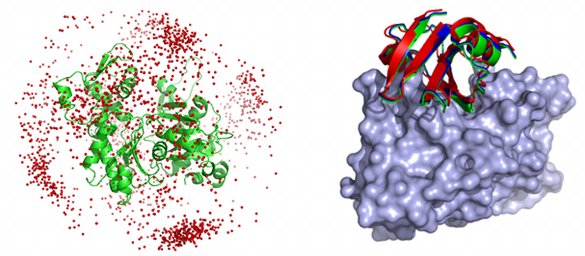
Masahito Ohue†, Yuri Matsuzaki†, Nobuyuki Uchikoga, Takashi Ishida, Yutaka Akiyama: “MEGADOCK: An all-to-all protein-protein interaction prediction system using tertiary structure data”, Protein and Peptide Letters, 21(8): 766-778, 2014.
[ PubMed | BenthamScience ]
Voxel-based scoring models
Building on our rPSC shape-complementarity model, we develop efficient scoring functions that account for electrostatic interactions and desolvation free energy.
- Masahito Ohue, Yuri Matsuzaki, Takashi Ishida, Yutaka Akiyama: “Improvement of the Protein-Protein Docking Prediction by Introducing a Simple Hydrophobic Interaction Model: an Application to Interaction Pathway Analysis”, In Proceedings of The 7th IAPR International Conference on Pattern Recognition in Bioinformatics (PRIB2012), Lecture Notes in Bioinformatics 7632, 178-187, Springer Heidelberg, 2012.
[ SpringerLink | Slide | Streaming(e-Bio) ]
High Performance Computing (HPC)
We develop protein docking software for parallel computers and supercomputers.
Masahito Ohue†, Takehiro Shimoda†, Shuji Suzuki, Yuri Matsuzaki, Takashi Ishida, Yutaka Akiyama: “MEGADOCK 4.0: an ultra–high-performance protein–protein docking software for heterogeneous supercomputers”, Bioinformatics, 30(22): 3281-3283, 2014.
Yuri Matsuzaki, Nobuyuki Uchikoga, Masahito Ohue, Takehiro Shimoda, Toshiyuki Sato, Takashi Ishida, Yutaka Akiyama: “MEGADOCK 3.0: A high-performance protein-protein interaction prediction software using hybrid parallel computing for petascale supercomputing environments”, Source Code for Biology and Medicine, 8(1): 18, 2013.
[ PubMed | BioMedCentral ]
Protein interaction network prediction
Protein interactions underlie enzyme reactions and cellular signaling. We use structure-based docking to rapidly identify protein pairs that may interact.
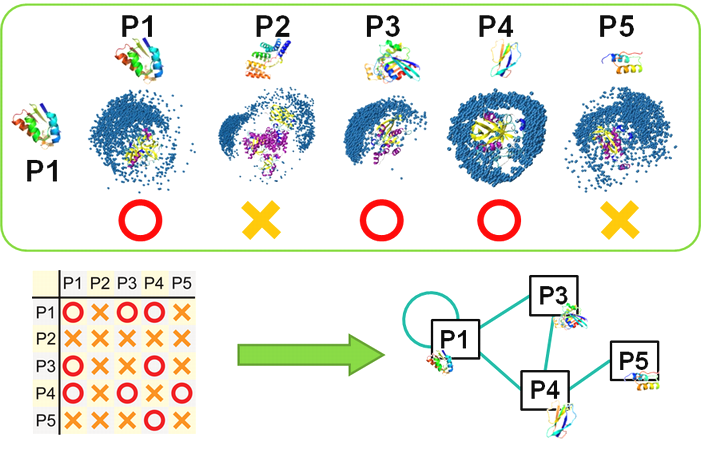
Masahito Ohue†, Yuri Matsuzaki†, Nobuyuki Uchikoga, Takashi Ishida, Yutaka Akiyama: “MEGADOCK: An all-to-all protein-protein interaction prediction system using tertiary structure data”, Protein and Peptide Letters, 21(8): 766-778, 2014.
[ PubMed | BenthamScience ]
大上雅史, 松崎由理, 松��裕介, 佐藤智之, 秋山泰: “MEGADOCK:立体構造情報からの網羅的タンパク質間相互作用予測とそのシステム生物学への応用”, 情報処理学会論文誌 数理モデル化と応用, 3(3): 91-106, 2010.
Protein-RNA interaction prediction
Many non-coding RNAs interact with proteins and participate in biological regulation. We adapt our protein interaction prediction methods to predict protein-RNA interactions.
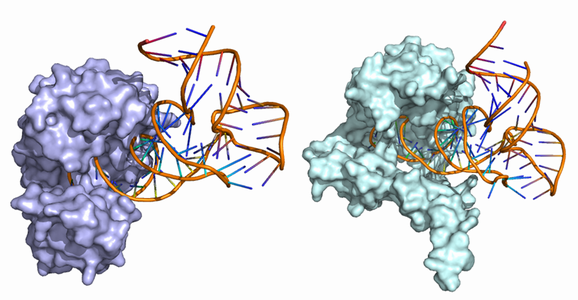
Masahito Ohue, Yuri Matsuzaki, Yutaka Akiyama: “Docking-calculation-based Method for Predicting Protein-RNA Interactions”, Genome Informatics, 25(1): 25-39, Aug 3 2011.
Application to bacterial chemotaxis
Taxis is movement in response to an external stimulus. For example, under nutrient starvation, E. coli expresses flagellar genes and moves toward higher nutrient concentrations through chemotaxis. This behavior is controlled by intracellular signaling systems that change their internal state in response to stimuli. Sensing external conditions and responding through internal-state changes is an interesting phenomenon related to the concept of learning. Flagellar motors regulated by chemotaxis systems are also studied as highly energy-efficient molecular motors, including for potential engineering applications.
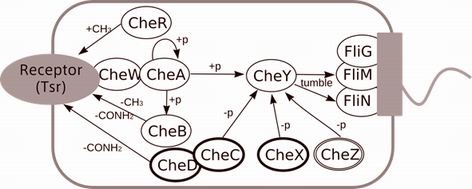
We evaluated MEGADOCK against known interactions in this system and investigated previously unknown interactions involved in its regulation.
Yuri Matsuzaki†, Masahito Ohue†, Nobuyuki Uchikoga, Yutaka Akiyama: “Protein-protein interaction network prediction by using rigid-body docking tools: application to bacterial chemotaxis”, Protein and Peptide Letters, 21(8): 790-798, 2014.
[ PubMed | BenthamScience ]
Application to human apoptosis
Apoptosis is a regulated cell-death process that contributes to the maintenance of an organism. Reduced apoptosis is associated with cancer and autoimmune disease, while increased apoptosis is associated with conditions including AIDS and neurodegenerative disease. Proteins in apoptosis pathways are therefore studied as drug targets.
We predicted apoptosis-related protein interaction networks with MEGADOCK and showed that combining docking with templates from known complex structures improves prediction precision.
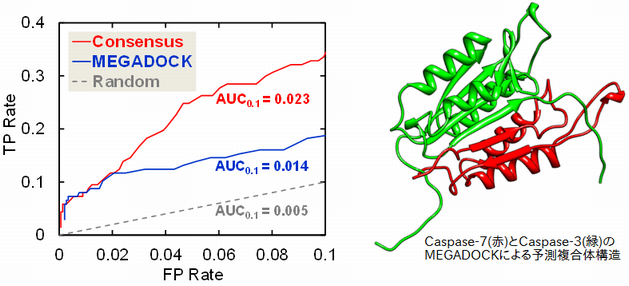
Masahito Ohue, Yuri Matsuzaki, Takehiro Shimoda, Takashi Ishida, Yutaka Akiyama: “Highly Precise Protein-Protein Interaction Prediction Based on Consensus Between Template-Based and de Novo Docking Methods”, BMC Proceedings, 7(Suppl 7): S6, 2013.
[ PubMed | BioMedCentral ]